Bingling Temple Grottoes: The Land of a Thousand Buddhas on the Yellow River
Travel in Lanzhou
Private Gansu Tours including Lanznou
Hot China City Tours
Table of Contents
- 1. Bingling Temple Fast Facts
- 2. What Is Bingling Temple? History and Background
- 3. Bingling Temple’s Highlights: What to See &Things to Do
- 4. How to Visit Bingling Temple
- 5. Discover Silk Road’s Buddhist Wonders with Easy Tour China
Located 80 southwest of Lanzhou, the Bingling Temple Grottoes, also known as Bingling Thousand-Buddha Caves, carved into the cliffs of a 60m high gorge is one of the more unusual sights in Gansu Province. This is one of famous Buddhist Caves in China. Isolated by the waters of the Liujiaxia Reservior on the Yellow River, the grottoes were spared the vandalism of the Cultural Revolution.
Different from other Silk Road tourist attractions, its unique location, completely isolated from any road access, has preserved the Bingling Temple Grottoes from vandalism and mass tourism for centuries. This is a true paradise for history lovers and photographer.
Bingling Temple Fast Facts
What Is Bingling Temple? History and Background
Bingling Temple was firstly built in A.D. 420 at the end of Western Qin, then the work continued and more caves were added. “Bingling” in Tibetan means “Thousand Buddha,” so Bingling Temple Grottoes are also called Thousand-Buddha Caves. At present, there are four layers in total with 183 caves and niches, 694 stone statues, 82 clay sculptures, and 900 square meters of murals.
On June 22, 2014, at the 38th session of the World Heritage Committee of UNESCO held in Doha, Qatar, Bingling Temple grottoes were successfully included in the world heritage list as a site of the “Silk Roads: the Routes Network of Chang’an-Tianshan Corridor” jointly applied by China, Kazakhstan and Kyrgyzstan.
Bingling Temple’s Highlights: What to See &Things to Do
The Splendor of Cave No.169
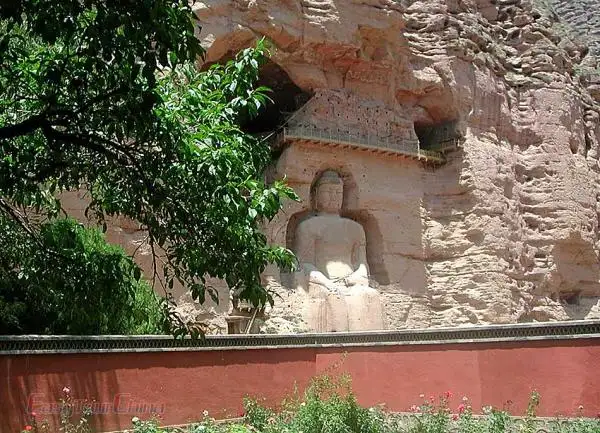
Cave No. 169 is the largest, earliest, and richest in content among the Bingling Temple caves, and it represents the essence of the Bingling Temple Grottoes and China’s ancient Buddhist art. It is located at the northern end of the cave complex, above the Tang Dynasty Great Buddha, more than 50 meters above the ground, and was originally a natural rock cave. It is 26.75 meters wide, 15 meters high, and 19 meters deep.
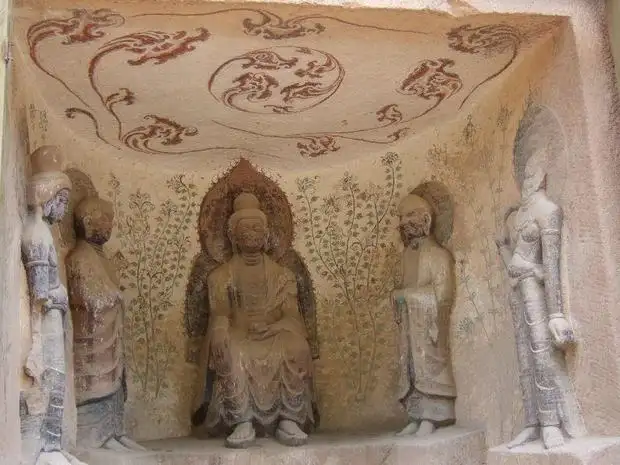
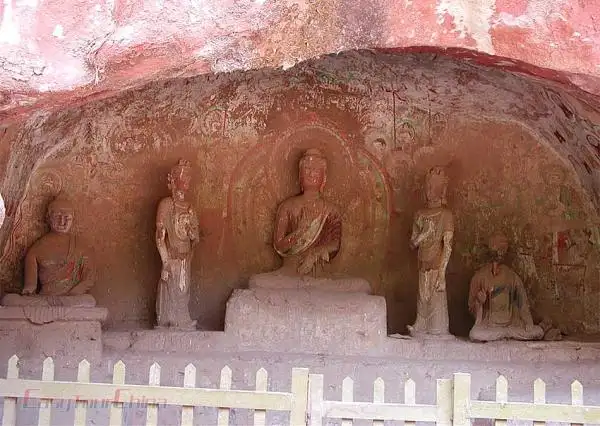
There are currently 24 Buddhist niches in the cave. The more representative niches are the 6th and 7th niches. The 6th niche is located on the north wall of the cave and is a semi-circular, tripartite lotus-shaped back screen niche.
Inside the niche is a sculpture of one Buddha and two Bodhisattvas, with the Buddha’s image vividly modeled and richly expressive.
Hidden Buddhist Caves in China– Sculptures Across Dynasties
Unlike many other grottoes in Gansu province, the Bingling Temple caves are famous for their wide variety of stone sculptures. Visitors can observe the evolution of Buddhist art styles across different dynasties:
Cave No. 169, 192 and 195 made in the Western Qin Dynasty (A.D. 385-431) show an obvious artistic style of Buddhism in the Western Regions. Most of the stone sculptures are fierce and vigorous. Cave No. 125, 128 and 132 are representatives of Northern Wei Dynasty (A.D. 386-534), which fully reflect the Central Plains Buddhist art style of fine and delicate features. From Northern Zhou (A.D. 557-581) to Sui (A.D. 581-619), the statues turned into an elegant and polished style with a well-shaped body.
Scenic Boat Trip through the Yellow River Canyon
Getting to the Bingling Temple Grottoes is half the adventure. There are two types of boats to reach the scenic area.
One is the speedboat from Donggan Pier, round-trip CNY 80, taking about 30-50 minutes. You can quickly enjoy the magnificent Yellow River Stone Forest and Danxia landform landscapes along the 30-kilometer waterway.
The other is a large boat departing from Liujiaxia Dam Pier, operated by the scenic area. The price is CNY 140-160 per person, and the journey takes about 2-3 hours. It moves more slowly, allowing you to enjoy more of the scenery along the way.
>> Recommended Amazing Silk Road Odyssey Tour from Xian
How to Visit Bingling Temple
How to Get to Bingling Temple
First, you need to take a bus from Lanzhou West Bus Station (兰州汽车西站) to Liujiaxia Dam. The bus ride takes approximately 2 hours and costs around 20 CNY.
After arriving at Liujiaxia Dam, you can board a sightseeing boat. After about 2-3 hours, you will reach at Bingling Temple Grottoes.
Essential Tips for Your Visit
>> Learn more about Lanzhou Travel Tips
Discover Silk Road’s Buddhist Wonders with Easy Tour China
The Bingling Temple Grottoes are just one of the many incredible Buddhist grottoes along the ancient Silk Road. If you are fascinated by ancient Buddhist art China has preserved in its cave temples, you will not want to miss the Mogao Caves in Dunhuang or the Maijishan Grottoes near Tianshui. Just let Easy Tour China help you craft the perfect Gansu tour. Here are some recommended itineraries.