
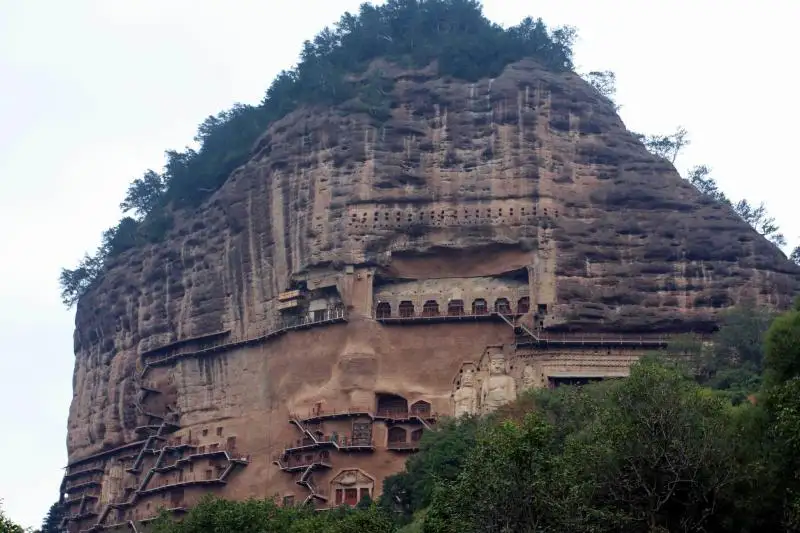
Maijishan Grottoes finds itself 35km southeast of Tianshui city, Gansu province, and is known as an appealing Buddhist site along ancient Chinese Silk Road. It was the major part of the Maijishan Mountain scenic area, which is 142 meters high, shaped like a pile of wheat and endowed with green cypresses and pines.
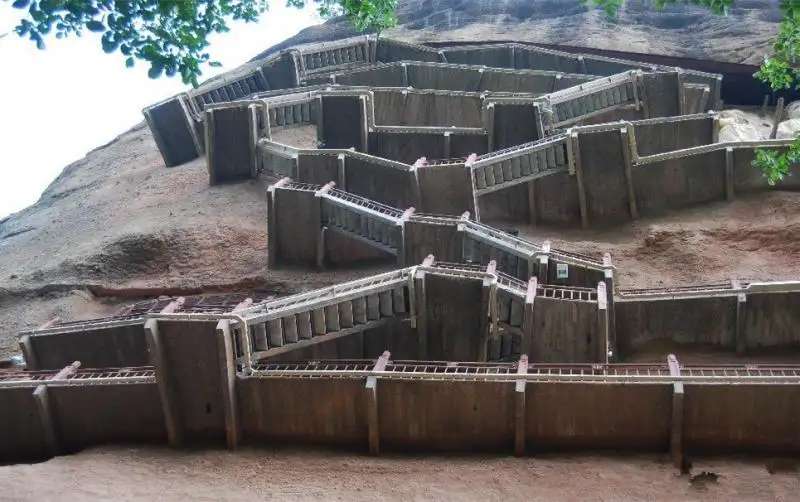
If the Mogao Grotto group is regarded as an ancient fresco museum, then Mount Maiji Grottoes is an “Oriental Statues museum,” being the finest example of China’s sculpture through the ages. It preserves 194 grottoes in all carved on the east and west cliffs of the mountain, resembling a huge honeycomb, with 7,200 pieces of clay or stone statues vividly carved and more than 1,300 square meters of mural paintings. The clay statues vary in height, from 16 meters to 10 centimeters, showing distinctive sculpture features of different dynasties in Chinese history. The Grottoes are connected by zigzagging plank roads, through which visitors can reach each cave successfully, and have a breathtaking experience.
Maijishan Grottoes Facts
A Short History – From the Sixteen Kingdoms to World Heritage
Maiji in Chinese means “piled sheaves of wheat.” That’s what Maiji Mountain looks like and why it got the name. Maijishan grottoes were firstly built in A.D. 384-417 and expanded in the following dynasties such as Northern Zhou (A.D. 557-581) and Tang (A.D. 618-907). Now there are 221 caves, 10632 clay sculptures and more than 1300 square meters of murals. It is famous for its exquisite clay sculpture art in the world and is renowned as the Oriental Sculpture Art Exhibition Hall.
Its excavation and renovation have continued through 12 dynasties until the Qing Dynasty (1616–1911). Because the caves are cut into a near‑vertical cliff, they survived many natural and human disasters. In 2014, the Maijishan Grottoes were inscribed as a UNESCO World Heritage Site as part of the “Silk Roads: Routes Network of Chang’an-Tianshan Corridor.”
>> Learn more about Famous Buddhist Grottoes in China
What to See & What to do at Maijishan Caves in China
Maijiashan Caves have seven ordinary caves open all year round: for special cave No. 133, No.135, and No. 127, each of them will need an extra fee of CNY 400 (within 5 people) or CNY 600 (6-10 people).
A Thrilling Walk Through The Cliffside Plank Roads
The most unforgettable experience at the Maijishan Grottoes is walking the wooden walkways that cling to the sheer cliff face. These paths were rebuilt many times over the centuries, and they offer spectacular views of the surrounding valleys.
Every step here brings you face to face with ancient statues and murals. Some of the boardwalks here are very steep, but once you climb them, you can experience the awe of overlooking the Maijishan Caves in Tianshui.
Cave No. 133
Cave No. 133 is the largest cave in Tianshui’s Maijishan Grottoes. As a must-see cave in Maijishan Grottoes, this place is called the “Thousand-Buddha Corridor.” Inside, the Northern Wei little novice in Niche 9 is a must-visit spot. This little novice is less than one metre tall, his face resembling that of a child under ten. When you lean over to look at his face, you will find a sweet smile on that adorable face, innocent and charming.
Cave No. 44
The main Buddha on the front wall of Cave 44 at Maijishan Grottoes is known as the “Smile of the East.” The Bodhisattva lowers its gaze, silent and serene, smiling at all sentient beings. This statue is reputed for its “Eastern Mona Lisa.” Some research suggests that it was modelled on Empress Yifu of the Western Wei dynasty and created by King Wudu in memory of his mother, hence its exceptionally kind disposition.
Cave No. 13
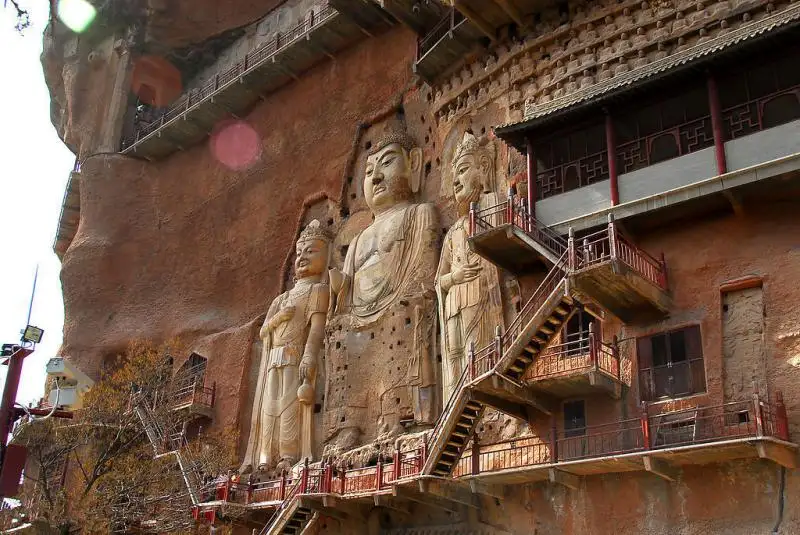
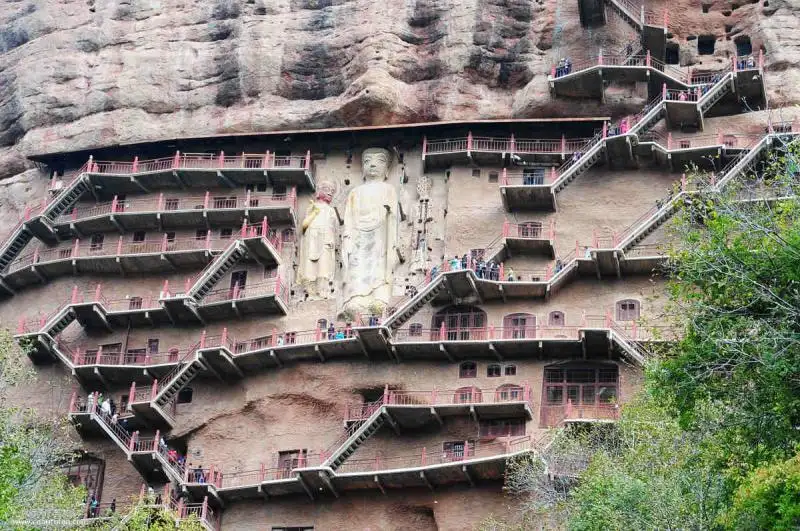
Cave No. 13 is commonly known as the “Eastern Cliff Great Buddha,” 17 meters high and 18 meters wide. It was chiseled in Sui Dynasty (A.D. 581-619) and rebuilt in Southern Song Dynasty (A.D. 1127-1279). This is the largest group of clay sculptures in Maiji Mountain with 15.7m high Amitabha Buddha in the middle, 13m high Avalokitesvara Buddha on the left and also 13m high Mahasthamaprapta Buddha on the right.
Cave No. 4
This cave is located above the three great Buddha on the Eastern Cliff, about 70 meters from the ground. It is the largest, highest, and most magnificent cave in Maijishan Grottoes.
Cave No.4 looks like a great palace with 7 rooms, in each of which stands a Buddha and decorated with apsara murals painted in Northern Zhou Dynasty (A.D. 557-581). Different from other murals, these in Cave 4 present a combination of mural and relieve, which endows the flying apsaras a strong three-dimensional sense and it looks like they will fly out of the wall at any moment.
Beyond exploring the caves themselves, the area offers several activities that can fill a full day or even two. Here are the best things to do during your Gansu tour:
How to Get to Maijishan Grottoes
From Lanzhou
First, just take a bullet train from Lanzhou West Railway Station to Tianshui South Station (about 1 hour 20 min). Then, from Tianshui South, you can take Bus No. 60 or No. 34 directly to Maijishan Scenic Area (about 1 hour).
From Xi’an
You should firstly take a bullet train depart from Xi’an North Station to Tianshui South in less than 2 hours (about CNY 100). Then follow as the same transport as Lanzhou’s.
Tips for Visiting Maijishan Grottoes
Explore Gansu’s Silk Road Treasures with Easy Tour China
Gansu is the home to other marvels like the Mogao Grottoes, the Jiayuguan Fort, and the ingenious Zhangye Danxia Landform Geological Park, offering you a comprehensive chance to seamlessly experience history, culture, and breathtaking landscapes on the Silk Road. Just let Easy Tour China help you craft the perfect Gansu tour to experience different things to do on the Silk Road. Here are some recommended Gansu itineraries.