Id Kah Mosque: Explore The Living Symbol of Islamic Culture in Xinjiang
Travel in Kashgar
Private Xinjiang Tours including Kashgar
Hot China City Tours
Table of Contents
- 1. Id Kah Mosque’s Facts
- 2. The History of Id Kah Mosque
- 3. Highlights and Things to Do at Id Kah Mosque in Kashgar
- 4. How to Visit Id Kah Mosque
Id Kah Mosque in the center of Kashgar Old Town is one of the landmarks of Kashgar, which enjoys a high reputation all over the world. The mosque is a sacred site for Muslims to worship, an extraordinary showcase of Islamic religious culture and a perfect fusion of distinctive Islamic architecture and Chinese traditional building styles.
Each day about 2,000 to 3,000 Muslims attend the routine service in Id Kah Mosque, and that number surpassed 6, 000 on the day of Djumah. During big festivals like Corban or Rouza (the Ramadan), the number can be more than 40,000 to 50,000.
Id Kah Mosque’s Facts
The History of Id Kah Mosque
When was the Id Kah Mosque built? It is said to be built by Saqsiz Mirza, King of ancient Kashgar Kingdom in 1442. In 1538, the supreme ruler reconstructed a small mosque to commemorate his uncle. That is the earliest appearance of Id Kah Mosque. During ancient times, the mosque served as an important academy for spreading Islamic culture and cultivating religious talents. In the first half of the 16th century, the mosque expanded and became a huge mosque which could host Friday Juma for prayers.
In 1798, a female Muslim Gulirena died on her way to Pakistan. People used her milage to extend the mosque again and named it Id Kah. A Uygur female millionaire afterwards donated and purchased 600 acres of land as part of the mosque. In 1809, an official reconstructed the mosque and added a gate, excavated a lake and canal inside. The mosque had another expansion together with Kashgar City during the Daoguang Emperor of the Qing Dynasty (in the early 19th century). The latest renovation happened in 1872 with a completely new layout.
Highlights and Things to Do at Id Kah Mosque in Kashgar
What is the largest mosque in China? Look no further, Id Kah Mosque is the largest mosque in Xinjiang and China. Here are its highlights.
Architecture of Id Kah Mosque in China
The mosque complex is composed of four main sections: the grand gate tower, a vast central courtyard, the hall for chanting scriptures (lecture halls), and the immense prayer auditorium.
The Iconic Yellow-Brick Gate
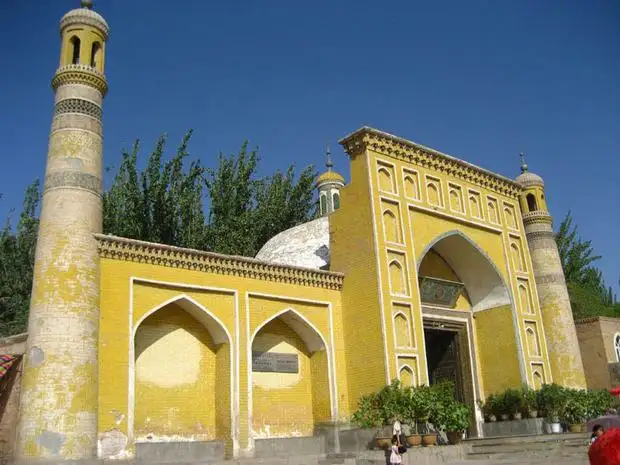
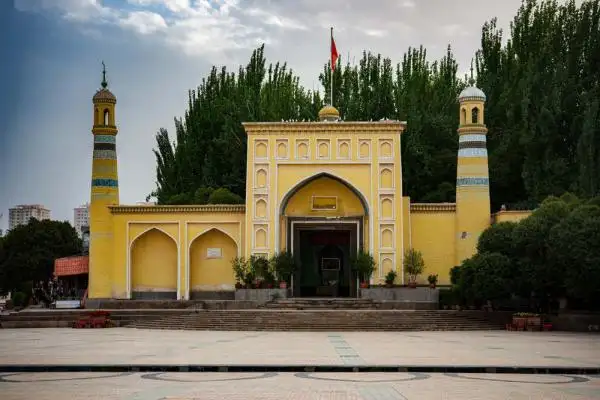
The main entrance faces west onto Id Kah Square, a lively public plaza where locals gather to relax and socialize. The gate is built from eye-catching bright yellow bricks with white plaster jointing, creating a striking visual contrast. Two towering minarets, each standing nearly 18 meters high, flank the entrance, their heads adorned with crescent moons—the universal symbol of Islam. The door itself measures 4.7 meters high and 4.3 meters wide, framed by elegant arched decorations that draw the eye upward.
The Central Courtyard (Sahn)
Pass through the gate, and you step into a peaceful 20-acre courtyard that feels like a hidden garden, where many towering trees, luxuriant plants and clear ponds can be seen. Lining its northern and southern sides of the courtyard are 24 scripture halls, where imams have taught generations of students the teachings of the Koran.
The Id Kah Mosque’s Interior
Go further inside, pass through a wooden fence, there stands two small yellow minarets in front of the Main Pray Hall. The Pray Hall is 140-meter long and 19-meter wide, consists of three parts: the outer Inner Pray Hall (Main Pray Hall), the external pray hall and entrance, which are all located on a higher platform above the ground. Its size is rarely seen in China and even worldwide.
One of the most cherished objects inside the main Prayer Hall is a 30-square-meter silk carpet from Iran, a gift that links Kashgar to its storied Silk Road past. Another notable piece is a woolen tapestry featuring 56 pomegranate flowers, symbolizing the 56 ethnic groups of China—a poignant reminder of the diverse cultural landscape of this region.
Friday Prayers and Festival Celebrations
If you’re interested in Islamic ritual, you can arrive on Friday afternoon, when the faithful gather for Djumah (the Day of Assembly).
The service begins at around 1:15 p.m., when the imam recites passages from the Koran in Arabic, then translates and explains them in the Uyghur language. Afterward, the entire congregation rises to pray in unison—a deeply moving spectacle that has continued unchanged for centuries.
>> Recommended 19-Day China Odyssey Tour for Muslims
How to Visit Id Kah Mosque
How to Get to Id Kah Mosque
You can take city bus routes No. 2, 7, 13, or 28 and get off at Id Kah Square Station to reach the mosque. Otherwise, If you are staying near by Kashgar Old Town, the mosque is within easy 8-min walking distance.
Best Time to Visit Id Kah Mosque
The best time to visit Kashgar—and by extension the Id Kah Mosque—is during the spring (April to June) and autumn (September to October) months. During these seasons, temperatures are mild and pleasant, with clear blue skies that make for stunning photography.
Tips for Visiting Id Kah Mosque in China
As Id Kah Mosque a religious site, during your travel to Xinjiang this time, you should pay attention to the following points.
>> Learn more about Kashgar Travel Tips
Explore Culture of the Western China with Easy Tour China
Beyond the Mosque, there are lots of things to Do in Xinjiang. Kashgar is just one gem along the legendary Silk Road. From the vibrant bazaars of Kashgar and the Abakh Hoja Tomb to the emerald lakes of the Tianshan Mountains, Easy Tour China will specialize in crafting unforgettable Xinjiang tours and Silk Road tours that take you deep into the heart of Central Asian culture. Here are some recommended itineraries.