Chengkan Village
Travel in Huangshan
Hot China City Tours
Chengkan Village, located in Huizhou District, Huangshan City, southern Anhui Province, nestled at the southern foothills of Huangshan Mountain, is a living masterpiece of philosophy and architecture.
The whole village was designed over 1,800 years ago, naturally surrounded by eight mountains and divided by the winding Longxi River, creating a breathtaking, living model of the Bagua map. It was constructed in accordance with the I Ching (易经)’s principles of “Yin (Kan), Yang (Cheng)” and based on the ancient Bagua (Eight Trigrams) principles; the village’s name itself reflected its foundational philosophy.
Visiting Chengkan Village Anhui will provide you a profound journey into Huizhou merchant culture. Here every lane, stream, and white-walled dwelling tells a story of harmony between humanity and nature. What’s more, it’s often called the “Bagua Village” or “Fengshui Village.” Due to its special location and layout, it has always been regarded as the Fengshui treasure land. And the truth is that it indeed cultivated many famous people and officials in the history of China.
Chengkan Village Facts
What to See in Chengkan Village
In Changkan Village, its several hundred ancient houses, ancestral halls, dwellings, pavilions, and bridges were built during the Yuan, Ming, and Qing Dynasties, and 22 national key protected cultural relics have won Chengkan the name of “the village with the largest number of Chinese national treasures.”Chengkan Ancient Village may be compact, but its intricate terrain features labyrinthine alleys. Below is a carefully curated itinerary highlighting the must-see attractions of Chengkan. Follow this route to leisurely appreciate the beauty of Huizhou architecture and Chinese I Ching culture.
>> Recommended 15 Days China Taoism Pilgrimage Adventure
Yongxing Lake (永兴湖)
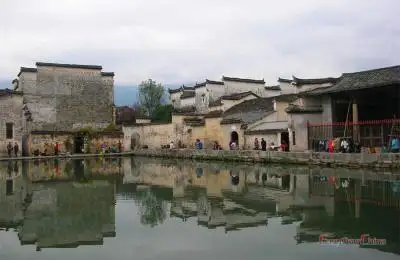
The visual journey begins at the serene Yongxing Lake at the village entrance. Acting as the “Shuikou” (water mouth) where all village streams converge, this lake is a classic Huizhou architecture element believed to gather prosperity. In summer, its surface is adorned with blooming lotuses, creating a picturesque reflection of the surrounding traditional Huizhou dwellings.Yanyi Hall (燕翼堂)
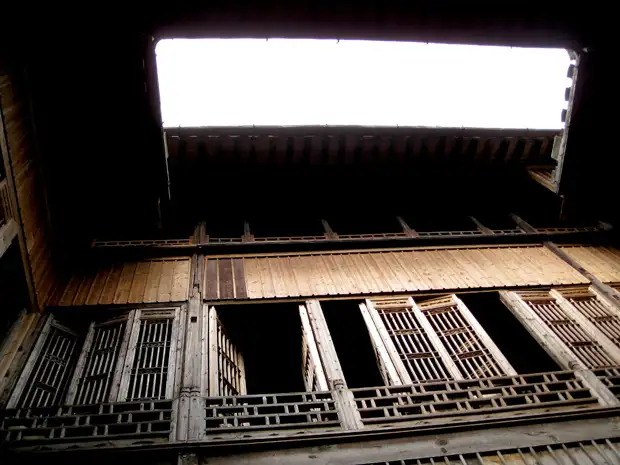
Yanyi Hall was the ancestral home of the Luo Ping family during the Qing Dynasty. It is the only extant structure in Chengkan Village with a main building dating back to the early Ming Dynasty, having been preserved intact for six centuries. As one of only eight surviving examples of high-rise Ming Dynasty residential buildings in Huizhou, its spatial layout reflects the evolution of clan settlement patterns.
Academics regard Yanyi Hall as a crucial specimen for studying ancient Chinese timber construction techniques, with its fire prevention design principles still offering valuable insights for modern fire engineering. The architectural complex aligns with Chengkan Village’s “Eastern Han Bagua” feng shui layout, forming a quintessential paradigm of Huizhou’s traditional village spatial morphology.
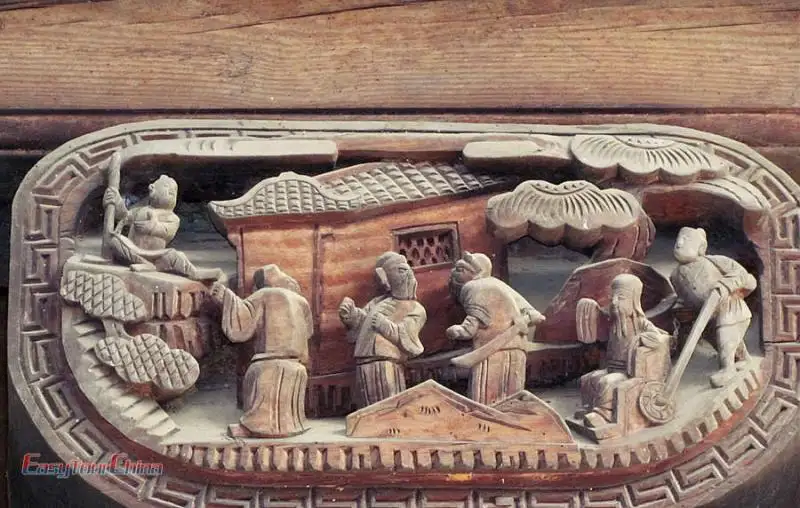
Luo Dongshu Memorial Temple (贞靖罗东舒先生祠)
The undisputed architectural heart of Chengkan Village is the Luo Dongshu Memorial Hall.This hall was constructed by the Luo clan to venerate their ancestor, Master Luo Dongshu. As the ancestral hall of one branch of the Luo family from Huangshan, it belongs to the category of clan ancestral halls. The hall is grand in scale and meticulously crafted, its architecture blending “antiquity, elegance, beauty, and grandeur” into one and it stands as a quintessential example of ancient Huizhou architecture and is acclaimed as “the foremost ancestral hall south of the Yangtze.”
The most remarkable feature within the ancestral hall is the rear chamber, Baolun Pavilion (宝纶阁). This hall was dedicated to safeguarding imperial decrees, edicts, and other imperial favors bestowed upon the Luo clan of Chengkan by successive emperors throughout history. The wooden components within Baolun Pavilion are intricately carved with various cloud patterns and floral motifs, showcasing exquisite craftsmanship. These unique stone, brick, and wood carvings are sure to delight your eyes.
Things to Do in Chengkan Village
Beyond sightseeing, you can also immerse yourself in the living culture of this village in Anhui to have an overview of the traditional Anhui-style architecture, experience the mysterious Feng Shui culture, take part in local activities in person.Participate in the “Passing the Kan” (Threshold) Ritual
In Chinese, “Kan” means both “threshold and misfortune.” Therefore, people in Chengkan Village believe that when you pass through the threshold, you will leave all your misfortunes behind.Near Yongxing Lake, you will find the special “Ping An Kan” (Peace Threshold). On either side stands a pair of mythical beasts called TUN, a feature unique to this village. These guardian deities are exclusive to Chengkan, symbolizing the swallowing of ghosts and demons.
As you touch the beast’s tongue, it consumes all the misfortune and evil energy accumulated throughout your life, leaving you with nothing but auspicious energy. When you touch its head, officials gain lifelong career fortune.
It is important to note that when crossing the Kan, one must follow a principle: men cross on the left, women on the right, and one must step over the central axis of the Kan.Witness the Autumn Sunning(晒秋)
If you visit Chengkan Village between September and November, you’ll be treated to a vibrant cultural display. Villagers dry their harvest of red chilies, yellow corn, and golden rice on open squares and along the lanes, creating a breathtaking patchwork of colors against the backdrop of Huizhou architecture and it has become a unique landscape in Chengkan.
>> Learn more about Huangshan Weather
Experience the Magical Fish Lantern Parade
Every evenings at 7:00 PM, the village comes alive with a traditional procession: the fish lantern parade. Locals carry glowing fish lanterns around Yongxing Lake and through the ancient alleys, with fireworks’ light and their lights dancing on the water and walls. It’s a mesmerizing spectacle that blends folklore with stunning visuals.How to Get to Chengkan Village
There are no flights or trains to Chengkan Village; you can only get there by car. As it is conveniently located about 30 km from Huangshan’s city center, the most straightforward way is to take a direct bus from the Huangshan Bus Station (Tunxi Long-distance Bus Station) to Chengkan. You’ll need to spend CNY 10 yuan to take the bus and arrive at Chengkan Village in about 50 minutes.or greater flexibility and comfort, you consider taking a taxi or booking a private car to Chengkan Village during your Huangshan travel. Upon arriving at Huangshan North Station by high-speed rail, you can take a taxi directly to Chengkan Village for CNY 40 yuan, with the journey taking approximately 30 minutes.
>> Recommended 4 Days Huangshan Student Tour with Cultural ExplorationDiscover Authentic Anhui with Easy Tour China
A half day is usually sufficient to explore Chengkan Village well. However, if you want to enrich your tour within other hidden gems in Shexian attractions, Huizhou, here are some attractions nearby you can choose:In Tangmo Village, you can explore another beautiful ancient village renowned for its elegant waterside gardens and serene atmosphere, or witness a majestic cluster of seven stone memorial archways spanning the Ming and Qing dynasties in Tangyue Archways, and go to Qiankou Residence Museum to visit a unique open-air museum featuring a collection of exquisite Ming and Qing dynasty traditional Huizhou dwellings that were relocated and preserved here.
To seamlessly experience this Fengshui village alongside the natural wonders of the Huangshan Mountain and other iconic villages like Xidi and Hongcun Village, let our Easy Tour China craft your perfect Huangshan tour itineraries. Here are some specialized itineraries about Huangshan City.