Yamdrok Lake: Facts, Hiking Itinerary & Photography Tips
Travel in Lhasa
Private Tibet Tours from Lhasa
Hot China City Tours
Table of Contents
- 1. Key Facts about Yamdrok Lake
- 2. Highlights of Yamdrok Lake - Attractions
- 3. Best Things to Do at Yamdrok Lake: Beyond Sightseeing
- 4. How to Visit Yamdrok Lake
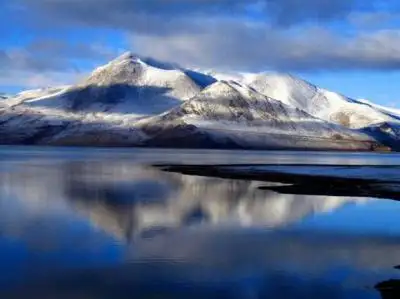
Also called Yamdrok Tso or Yamdrok Yumtso, it means “Jade Lake” in Tibetan language and is regarded by Tibetans as one of the three sacred lakes. The lake is 110 km southwest of Lhasa, and encompasses an area of 638 square kilometers, The Yamdrok Lake has an elevation of 4441 meters above sea level with an average depth of 30 meters. The lake is surrounded by many snow capped mountains and fed by the numerous small streams.
It is a highland freshwater lake with a dozen of islands, the largest of which is about 3000 square meters. In the summer, many different types of aquatic birds fly here to mate and lay eggs. There are shoals of fish in this lake. Every year from April to October, the local people catch fish here and sell in the market of Lhasa.
On your Tibet tour, head to this gem-like alpine lake for photography and wandering around to take in the sweeping landscapes of Tibetan Plateau.
Key Facts about Yamdrok Lake
How It Was Formed?
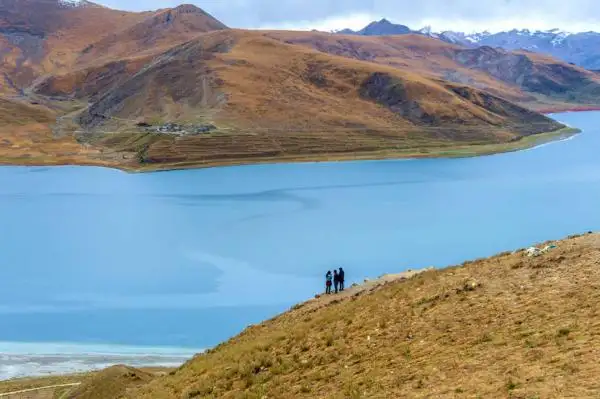
Yamdrok Yumtso is a typical highland dammed lake. It is said that it was formed by the blocking of the river channel due to glacial mudflows approximately 400 million years ago. Its shape is highly irregular, with many branches, and the lake shore is winding and curving.
It is also accompanied by three smaller lakes: Khamo Lake, Chenpo Lake and Jorpo Lake. Historically, it was an exorheic lake, and the above lakes were connected as one. The lake water flowed into the Yarlung Zangbo River. However, later due to the retreat of the lake water, it became an endorheic lake and divided into several smaller lakes. The difference in water level among these lakes is no more than 6.5 meters.
What’s the Color of Yamdrok?
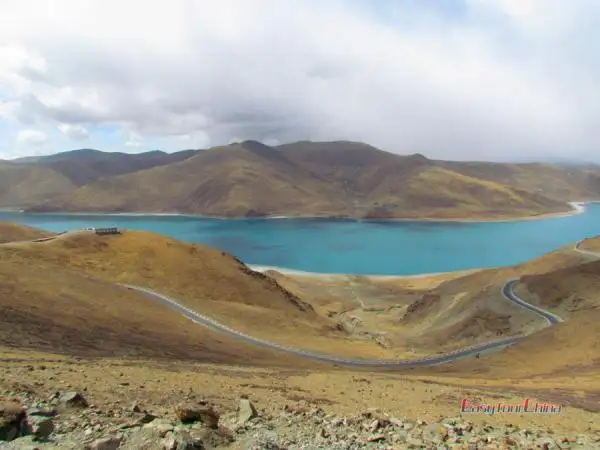
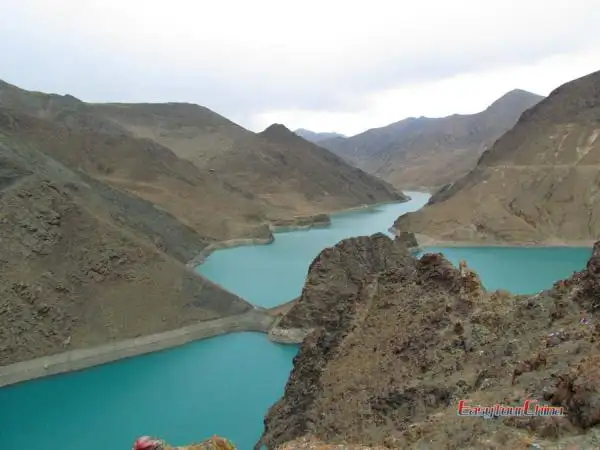
The water color of Yamdrok Tso Lake changes over time, depending on the weather, light, and even the angle of observation. On sunny days, it takes on shades of sea blue, peacock blue or deep azure; on cloudy or overcast days, it appears in shades of indigo or gray. And as the day turns into evening, under certain lighting conditions, the lake water can take on a dreamy pale green hue.
>> Discover the most famous lakes in China
Why Is It a Holy Lake?
In Tibet, the sacred lakes are low-concentration saltwater lakes and are important habitats for birds such as swans, fish eagles, and bar-headed geese. The three major sacred lakes in Tibet are Manasarovar, Namtso, and Yamdrok Yumtso. Yamdrok Lake is the largest waterbird habitat in southern Tibet. Every winter, flocks of birds migrate southward to this place. On the lake shore and the island in the middle of the lake, there are many swans, water geese, yellow ducks, fish eagles, and bar-headed geese.
People venerate Lake Yamdrok primarily as Yamdrok Tsongkhapa, the Great Lake Goddess Dorje Gyaltsen, also known as the Vajra Obstacle Goddess, a female protector deity of Tibet. Therefore, Lake Yamdrok is both an incarnation of the Dragon Girl and the abode of the female protector deity, possessing multiple functions and divine powers.
>> Further explore 10 Best Things to Do in Tibet
Highlights of Yamdrok Lake - Attractions
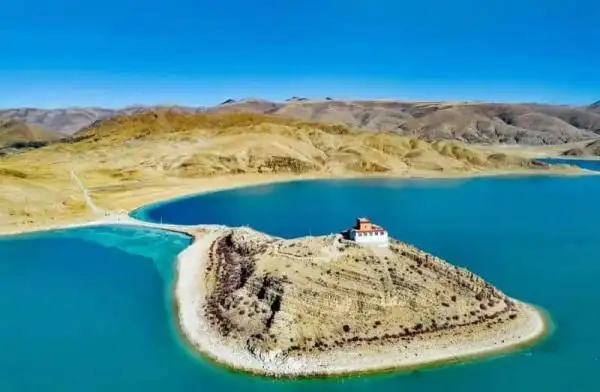
Seduo Island
Seduo Bird Island stands approximately 15 meters tall. The island’s slopes are relatively gentle, and the ground is covered with gravel. Plants such as Datura, yellow-flowered wood, and purple vetch grow in the crevices of the rocks. There is also a stone hut that serves as a temporary residence for local bird wardens during the breeding season.
Sedo Bird Island is home to over 2,800 nests. At peak times, the population of bar-headed geese reaches approximately 7,500, while that of brown-headed gulls exceeds 7,000.
Furthermore, Sedo Bird Island is one of the three sacred bird islands of Lake Yamdrok.
Rido Island
Rido Island is so small that it is not even shown on some maps. However, because it is home to Rido Monastery of the Sakya School, it attracts a significant number of pilgrims. According to local tradition, when a person living near Yamdrok Lake passes away, their relatives must come to this monastery to light lamps and burn incense in hopes of receiving blessings. The monastery also houses a precious butter lamp made of gold.
Rito Temple
Perched on a mountaintop, Rito Temple, like the temples in Lhasa, features red and yellow architecture and boasts a history of over 700 years. Perhaps due to its remote location, this temple remains relatively unknown, and is regarded as the most lonely temple in the world.
A legend of “one lake, one monk, one temple” is passed down at Rito Temple. The temple has a total of three monks, with one taking turns to reside there each day. Inside, a sacred stone said to have fallen from the sky is enshrined; it is believed to cure all illnesses, which is why Rito Monastery is also known as “The Stone on the Mountain.”
Sangding Monastery
Sangding Monastery is situated 5 kilometers east of Langka County. It was built by Shedogyi Pamo Chogyi Zhenmei in the fifth year of the Zhengtong era of the Ming Dynasty (1440). It is the only monastery in Tibet where a female tulku serves as the abbess.
In front of the monastery lies the sacred Lake Yamdrok, which winds around the monastery like an offering lamp, surrounded by mountain ridges. The surrounding area features jade-green grasslands, blooming flowers, and lush greenery.
It is said that devout Buddhists make a full circuit of the lake every 12 years during the Year of the Sheep (a journey that takes about a month on horseback). This is equivalent to making a pilgrimage to Lhasa; by doing so, the Buddha will bless them with good fortune and prosperity for the year, while also dispelling misfortune, accumulating merit, and preparing for spiritual practice in the next life.
>> Recommended Tibet tours to Yamdrok Lake
Best Things to Do at Yamdrok Lake: Beyond Sightseeing
Hiking
For serious hikers, we recommend a 9-day trekking route around Yamdrok Lake:
Day 1: Lhasa (by bus) → Gonggar County (by bus) → Langda Village (start trek) → Butang Monastery → Jiedexiu Town → Langjiexue Township
Day 2: Butang Monastery → Jiara Pass → Zayu Village (camping)
Day 3: Zayu Village → Zhangda Township → Gongbuxue Township → Qiangbalin Monastery
Day 4: Gongbuxue Township → Nimalong Village
Day 5: Nimalong Village → Tebula Village → Duoque Township
Day 5: Duoque Township → Dalong Town
Day 6: Dalong Town → Langkazi County → Azha Township
Day 7: Azha Township → Yongbuduo Ferry Crossing → Yongbuduo Monastery
Day 8: Yongbuduo Monastery → Azha Township → Langkazi County → Lhasa
Tips for Yamdrok Lake Trek
- This route is suitable for outdoor enthusiasts with much hiking experience.
- It is strongly recommended to travel in groups of two or more. Along the entire route, there are some sections where you are unlikely to encounter people. If you are traveling as a small group, the probability of encountering danger is lower.
- Carry supplies for at least two days: During the journey, there will be at least two midday periods when food supplies cannot be found. Some small villages along the way can only provide some low-grade instant noodles and other foods.
- At the camping sites along the way, there will be strong winds at night. Therefore, a double-layer tent with good wind resistance is very necessary. The lowest temperature at night will reach minus 10 degrees Celsius, and sometimes it can even reach minus 15 degrees Celsius. Therefore, a sleeping bag that can withstand temperatures below minus 10 degrees Celsius is also necessary.
- Carry a first aid kit and some common medicines.
- Personal equipment: hiking shoes, windproof pants (there are many thorny bushes along the way), down jacket, headlamp, camp lamp, backpack with a capacity of more than 60 liters and a good load-bearing system, hat, multi-functional headscarf, map, knife.
- Most of the local herdsmen are very friendly. When you need help, just ask them.
>> Explore 10 Best Trekking Trails in Tibet
Photography
Best shooting locations: Gangbala Pass Observation Platform (at an altitude of approximately 4,998 meters), Longka County Lake Road, Open Lake Bay Shoal, Logupu Observation Platform, South Slope of Togar Peak
Aerial photography is a good method for capturing Yamdrok Yumtso. However, due to the vast size of the lake, it is recommended to fly at an altitude of 500 meters to capture the panoramic view. The light gradually changes from morning to afternoon, and the best light is at noon, which is suitable for shooting people and natural scenery.
Best shooting time: 6:30 - 8:00 in the morning and 18:00 - 19:30 in the evening
Paragliding
Beside Yamdrok Yumtso Lake, the world's highest paragliding base at the third pole of the earth has been built.
The paragliding program offers two options, Point A and Point B. Both take off from the designated coordinates and operate within a 5-kilometer radius. The fee for Point A is CNY 1,580 yuan, and the fee for Point B is CNY 1,880 yuan.
Point A: The take-off field is 5 mu, located at Zhamalong Village, Bai Di Township, Gangbarala Observation Platform, Langkaesu County, Shannan City. The altitude is 5109 meters. The landing field is 20 mu: the altitude is 4443 meters.
Point B: The take-off field is 5 mu, located at Zhayu Village, Zhangda Township, Yangzodra Observation Platform, Langkaesu County, Shannan City. The altitude is 5054 meters. The landing field is 20 mu: the altitude is 4477 meters.
Please note: The flight conditions are determined by wind direction, wind speed and the weather conditions of the day.
How to Visit Yamdrok Lake
Getting to Yamdrok
Travel from Lhasa, you can have a road trip with a private car, or take public transportation to Yamdrok Lake. The journey takes approximately 2-3 hours.
Where to Stay - Accommodation
Near Yamdrok Lake, there are some local guesthouses available with very basic facilities and services, allowing you to experience local life. If you prefer more comfortable accommodations, return to Lhasa city or go to Shigatse.
Yamdrok Lake Weather & Best Time to Visit
The average annual temperature in the Yamdrok Lake basin from 1971 to 2009 was approximately 2.9℃, with the annual average temperature curve generally showing an upward trend.
Compared to spring and summer, autumn and winter are the best seasons to visit. First, it doesn't rain in autumn and winter. Second, a large number of migratory birds come to Yamdrok Lake to overwinter in autumn and winter, making the scenery more vibrant. Third, the snow-capped mountains surrounding Yamdrok Lake are more beautiful in autumn and winter.