Wuyuan Villages – Explore the Most Beautiful Countryside in China
Table of Contents
- 1. Quick Facts of Wuyuan
- 2. Best villages to visit in Wuyuan, Plus the Hidden Gems
- 3. Top Things to Do in Wuyuan
- 4. How to Get to Wuyuan
- 5. Wuyuan Weather & Best Time to Visit
- 6. Where to Sty in Wuyuan: Hotels
Located at the northeast of Jiangxi, Wuyuan villages enjoy a high reputation of the most beautiful countryside in China, by possessing well protected traditional villages and pristine ecological landscape.
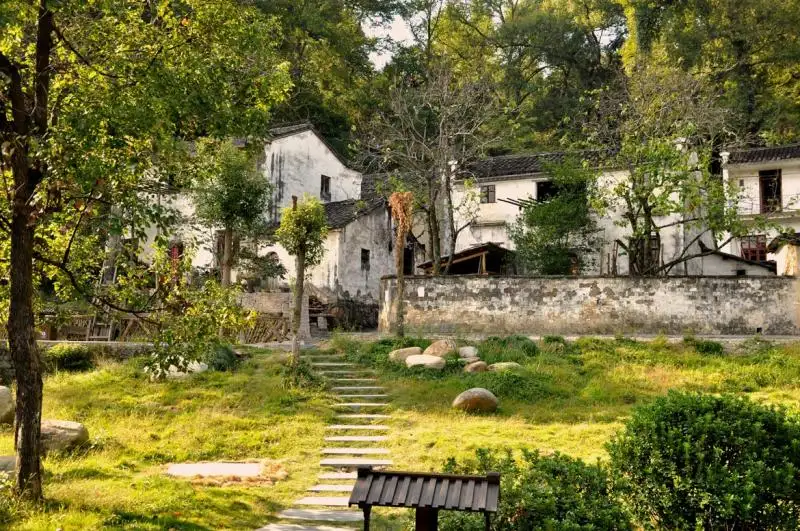
Visitors who explore in Wuyuan villages will see the traditional architecture in every village look almost the same, with China’s unique and ancient Huizhou style - of white walls, black roofs, elegant eaves, and dark-green footstones. Many of the residential houses were built in Ming and Qing Dynasty. Strolling in the streets may give you an illusion that you are going back to the old time of China.
Wuyuan is also renowned as an eco-tour destination in China, where the world’s biggest wild mandarin ducks’ habitat is located. With an 81.5% cover of vegetation, Wuyuan is just like a large forest park.
Our Wuyuan travel guide brings up the iconic & hidden villages, best things to do, and travel tips of Wuyuan photography, enabling you to plan a bespoke Wuyuan tour the best most beautiful season.
Quick Facts of Wuyuan
Tracing the Origin of Wuyuan - History
Based on the analysis of the unearthed pottery spindles, stone net weights, bone needles, round-bottomed net-patterned pottery jars, painted pottery fragments, stone axes, and stone chisels from villages/places like Shan Shan, Jiang Cun, and Maotanzhuang within Wuyuan County, it can be concluded that as early as 4,000 years ago, the ancient Yue people had settled and lived in this area.
They regarded snakes and birds as their totems, giving rise to the Yue ethnic culture represented by painted pottery, and established several primitive settlements, belonging to the San Miao tribe. In the later period of the Xia Dynasty (approximately 2070 BC - approximately 1600 BC), one branch of the ancient Shang Yue people became more powerful than others and flourished here.
Best villages to visit in Wuyuan, Plus the Hidden Gems
The Best Villages to Visit on Your Wuyuan Tour:
Huangling Village (in Jiangwan Town)

CNN named it one of the most beautiful villages in China. With nearly 600 years of history, Huangling Village is nestled against Shi'er Mountain, surrounded by thousands of ancient trees and thousands of acres of terraced fields. Huangling Village's unique topography, characterized by its scarcity of flat land, has created a distinct and well-arranged village layout. Terraced fields cascade down the slopes, with houses arranged in a fan-shaped, staggered pattern around the watercourses, a style known as "Ladder Cloud Villages."
Due to the scarcity of flat land, rooftop drying racks have become the primary method for drying crops – every household extends their entire rooftop with drying racks. Huangling calls this scene of drying crops "Autumn Drying." The "Autumn Drying" refers to the harvest, so it's not exclusive to autumn; seasonal crops can be dried year-round.
"Autumn Drying," together with the ancient Hui-style houses and terraced fields, makes Huangling one of the best places for photography and for Chinese painters to sketch.
>> Recommended China photo tours: 9-day Photography Tour of Hangzhou/Wuyuan/Yellow Mountain
Jiangwan Village (in Jiangwan Town)
Founded in the early Tang Dynasty, Jiangwan Village is one of the best-preserved traditional villages in China. During the Tang Dynasty, it was initially called "Yunwan Village" because of the surrounding mist. In the second year of the Yuanfeng era of the Song Dynasty, Jiang Di, the eighth-generation ancestor of the Xiao Jiang clan, moved to Jiangwan, where his descendants multiplied and gradually became a large clan. In the early Qing Dynasty, the village was renamed Jiangwan after his surname, a name that remains to this day.
The village also preserves well-maintained imperial censor's residence, official residences from the Ming and Qing dynasties, including the ruins of the Jiang family ancestral home with "one courtyard and six mansions," the Teng family old house in the Hui-style style, the Sansheng Hall, and Hui-style merchant residences, as well as the Xiao Jiang Ancestral Hall. In addition, there are Dunchong Hall, Peixin Hall, Donghe Gate, and the dam well.
Likeng Village, Qiukou Town
Another famous ancient village in Wuyuan China, Likeng Village was founded in 1010 AD (the third year of the Dazhong Xiangfu era of the Northern Song Dynasty) by Mr. Li Dong. It has been quietly hidden in the mountains for over a thousand years.
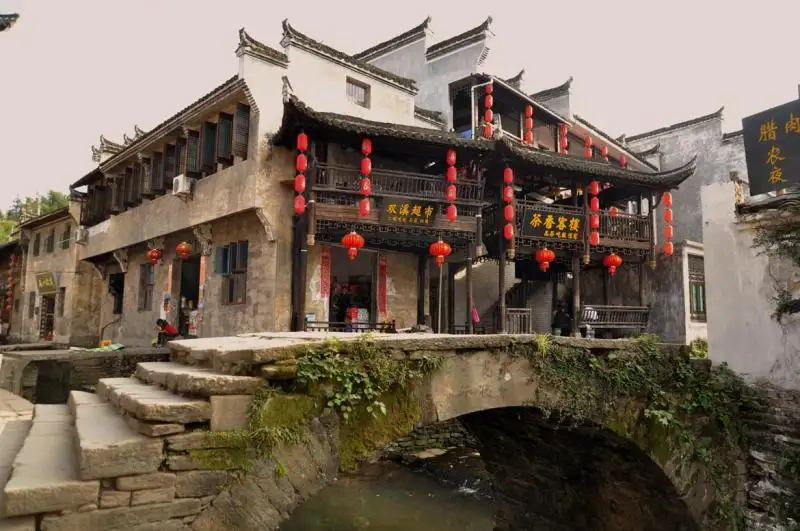
A network of bluestone paths crisscrosses the streams, with small bridges spanning them. Houses line both sides of the streams, forming a water street – a unique style of Huizhou architecture. The ancient Hui-style buildings here are well-preserved, including arched bridges, pavilions, temples, and courtyards, including the former residence of Li Zhicheng, a military champion of the Southern Song Dynasty.
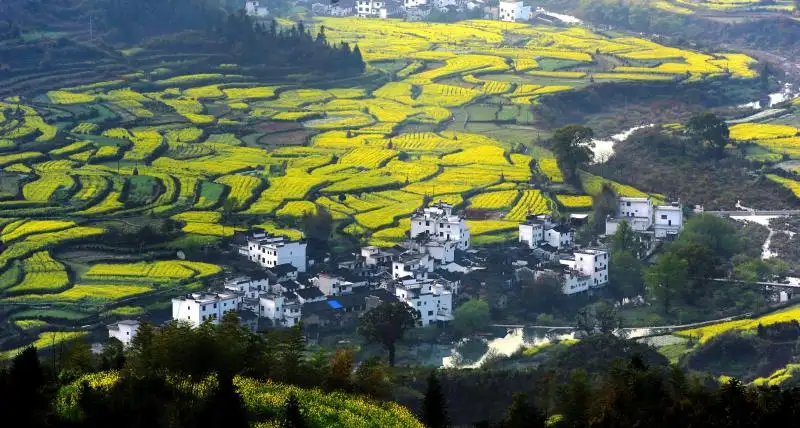
In front of the village are vast fields of rapeseed flowers, turning the mountains and fields golden in spring.
>> Recommended 5-day Jiangxi Tour: Wuyuan, Wangxian Valley, Mt. Sanqing
Wangkou Village (in Jiangwan Town)
Wangkou Village is located in eastern Wuyuan. Founded during the Daguan era of the Song Dynasty by Yu Gao, a high-ranking official (a third-rank official), it has a history of over 1100 years. It is an ancient village primarily inhabited by the Yu clan. Historically, Wangkou Village was an important waterway trading port in Wuyuan.
Over 95% of the buildings in the village still retain the characteristics and style of the Ming and Qing Dynasties. The layout is roughly grid-like, with one main street and eighteen main lanes leading directly to the river wharf.
The main east-west street in the village—the main street—is 670 meters long, paved with bluestone slabs and lined with shops. At its peak, there were over 120 shops throughout the village, and 66 ancient shop buildings still exist on the main street.
In addition, there are ancient and elegant residences such as "Yijingtang", "Maodetang", "Daifudi" and "Yangshuwu"; as well as the ruins of the "Pingduyan" curved-edge stele designed by Jiang Yong, a Qing Dynasty scholar of classics and phonology.
Less-known Villages in Wuyuan: Equally Beautiful, yet More Tranquil, and Possibly Free:
Yan Village (in Sikou Town)
The village is paved with bluestone slabs, leading to ancient Ming and Qing dynasty buildings. Backed by green mountains, it faces a clear stream and rice paddies. Yan Village has 156 ancient residences, including 5 Ming dynasty buildings and over 80 Qing dynasty buildings, covering an area of approximately 16,000 square meters.
Most of the ancient residences have white walls and black tiles. The white walls are inlaid with several small windows of varying heights. The interior and exterior walls emphasize the architectural styles of horse-head gables and wall gables.
Likeng Village (in Tuochuan Township)
Founded in the late Northern Song Dynasty, Likeng Village is located on the southern slope of Tuofengjian, a spur of the Dazhang Mountains. The Liyuan Stream, originating from Fuge Mountain, flows around the southeast of the village, creating a village layout that is nestled against the mountain and facing the water. This ancient village has a history of over 900 years and contains nearly 200 Hui-style old houses.
Today, the well-preserved ancient buildings include the "Official Residence" of Yu Ziyi from the Ming Dynasty, the "Heavenly Official and High Minister" of Yu Maoheng from the Ming Dynasty, the "Minister's Residence" of Yu Maoxue from the Ming Dynasty, the "Sima Residence" of Yu Weishu from the Qing Dynasty, the "Yiyu Hall" of Yu Xianhui from the Qing Dynasty, as well as the garden-style "Yunxi Villa," the garden-style "Flower Hall," and the legendary "Jin Family Well."
Sixi Village (in Sikou Town)
Founded in 1199, it still retains 91 ancient buildings, including 84 residences, one ancestral hall, one covered bridge, one stone slab bridge, and over 30 streets and alleys paved with bluestone slabs. There are also four exquisitely crafted river wharves, also paved with bluestone slabs.
Jujing Village
This 800-year-old village is named for its perfect circular layout, making it one of the roundest villages in China. Standing on the small hill opposite the village, you can overlook the entire Jujing Village from halfway up the hill.
The most interesting part is exploring the village's alleys. The seemingly chaotic stone paths all lead to the central threshing ground. Every household's back door faces the stream, making washing vegetables and clothes a convenient one-stop solution. At the entrance of the "Centennial Tofu Workshop," the proprietress is chilling tofu with stream water.
Shangtan Village
It is a secluded and unassuming little village. Explore its ancient camphor trees and ancient buildings by strolling or taking a bamboo raft.
>> Attractions nearby Wuuan: Wangxian Valley - the Cliffside Wonderland in Jiangxi
Top Things to Do in Wuyuan
A trip to Wuyuan promises an extraordinary experience, ranging from the exquisite "three types of carvings" to the ancient Nuo Opera, from the carving of She Inkstone to the singing of Huizhou Opera.
Dive Deep into Huizhou Architecture
Wuyuan, one of the six counties in ancient Huizhou, has over 4,100 ancient buildings, especially those from the Ming and Qing dynasties. The "three types of carvings", namely brick carving, stone carving, and wood carving, belong to the architectural art of Huizhou. When you travel to Wuzhou Village, Lihekeng, and Sishixian Village, carefully observe the gate towers, beams, and window frames. Brick and stone carvings are mostly used for exterior decoration, while wood carvings are more often seen in indoor screens and railings, with patterns mostly being auspicious motifs such as flowers, birds, or historical anecdotes.
When you step into each Huizhou ancestral temple, the "spiritual court" of each family, don't miss its architectural regulations, plaques, couplets, and carvings.
>> Recommended 10 days Hangzhou Wangxian Valley Wuyuan Huangshan Shanghai Tour

Immersive Cultural Journey
Watch the performance of Huizhou Opera (one of the predecessors of Peking Opera) on the ancient stage of the Tianjie Street of Huangling Village. Even try on the costumes and learn the dance moves. During festivals, watch the mysterious mask-wearing Nuo dance in ancient villages like Li Keng. Visit the Shexian inkstone workshop, observe the artisans' carving, and even make a small inkstone yourself. And in Jialu Village, you can see the production of the intangible cultural heritage oil-paper umbrella.
Wuyuan Photography
The renowned fields of sunflowers, the ancient and simple architectural style of the Huizhou style buildings, the year-round "harvest drying" activities, as well as various unique cultural elements provide countless photography opportunities.
Easy Tour China's photography tips: The "harvest drying" scene and night view in Huangling, the local life in Likeng, the terraced flower fields in Jiangling in spring, and the red maple leaves and morning mist in Stone City in autumn are the best for taking great photos.
Tea Culture Experience
The green tea-making technique in Wuyuan is a national intangible cultural heritage. Travel to the villages of Wuyuan around April is the best time to experience tea culture. At Linsheng Tea Farm, Kaoshui Tea Garden or Changxi Village, you can not only taste the tea, pick tea leaves, but also experience the entire tea-making process.
How to Get to Wuyuan
By High-speed Train
Travel from Hangzhou, Nanchang, Hefei, Fuzhou, Shanghai to Wuyuan by high-speed rail. The journey takes between 1.5 and 3 hours. For a closer route, from Shangrao, Huangshan, Jingdezhen to Wuyuan, the high-speed rail journey only takes 30 to 40 minutes.
By air
There is no airport in Wuyuan. The nearest airports are Ruji Airport in Jingdezhen (about 80 kilometers away) and Tunxi Airport in Huangshan (about 90 kilometers away).
Wuyuan Weather & Best Time to Visit
The best time to visit Wuyuan is in spring (March-April), when golden rape flowers dotted in the hills and valleys bloom, creating a gorgeous picture of rural China. At the moment, Wuyuan villages are just like a dreamlike paradise, especially for photographers. The temperature in spring is around 12 to 25 degrees.
Here, you can take pictures of old camphor trees and dazzling rape flowers, or leisurely walk on the mottled wooden covered bridges, or linger by those aged ferries and folk houses. The stunning landscape and authentic local lifestyle make your trip in Wuyuan such a joy with unique experience!、
Where to Sty in Wuyuan: Hotels
You can choose to live in Wuyuan county, or for a more authentic experience, stay overnight in villages such as Huangling, Sixiyan Village, Jiangwan, or Li Keng. You can choose from international chain hotels to boutique guesthouses.
Recommended 3-day Wuyuan itinerary
Day 1: Wuyuan Station → Huangling (Overnight in Huangling or Jiangwan)
Day 2: Jiangwan, Xiaoqi, Shangtan, Jiangling
Day 3: Sixi Yancun, Rainbow Bridge, Moon Bay
More trip ideas in March