China's famous Taoist mountains, from Sanqing Mountain in Jiangxi and Laoshan Mountain in Shandong to Qingcheng Mountain in Sichuan, are all spiritually beautiful and otherworldly -- suitable for spiritual cultivation. However, Wudang Mountain in Hebei, the foremost Taoist mountain, exudes a more noble air. Geographically, although located in the south China, it is very close to the north. Its mountain terrain, and vegetation differ from other famous southern mountains, possessing a more majestic and imposing presence. Perhaps, more importantly, Wudang Mountain's grand and noble aura stems from its status as the ancestral temple of royal family of the Ming Dynasty.
Today, Wudang Mountain, standing as a living monument to China's profound Taoist heritage, serves as the spiritual and martial headquarters of the legendary Wudang Sect. Here, amidst ancient palace-like temple complexes and misty peaks, generations of Taoist priests have upheld a strict code of principles. These "pure rules and monastic precepts" govern everything from daily rituals and diet to meditation and martial arts training.
This article will guide you through the origin of Wudang Mountain, unlocking the mountain's true cultural identity, Wudang sect and the way of Taoist priests' life that has remained largely unchanged for over six centuries.
Seek the Taoism on Mt. Wudang: Three Questions
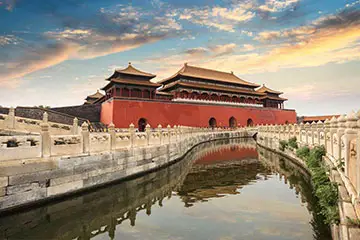
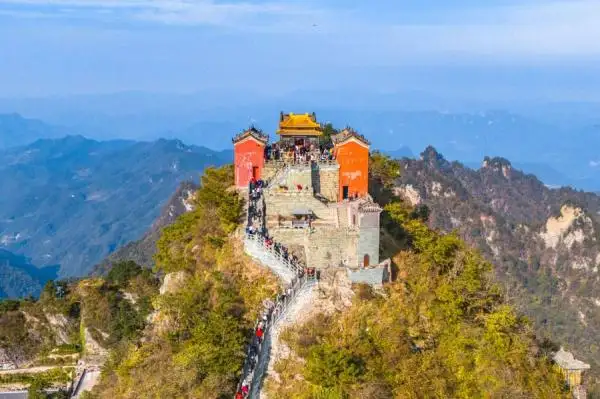
From the foot of the mountain upwards, from Yuxu Palace all the way to the Golden Summit, Wudang Mountain is completely different from other Taoist mountains in terms of its aura and details. Yuxu Palace is like a palace, and a very large one at that, although its current size has been reduced by one-third due to railway construction. The two stone tablets of Yuxu Palace surpass the scale of most palaces in the country.
More than 600 years ago, Emperor Yongle of the Ming Dynasty spent 300,000 people to transform the entire Wudang Mountain into the ancestral temple of the Ming Dynasty. During the reign of Emperor Jiajing (1507-1567), a large-scale renovation was carried out. It is said that the prime minister Yan Song led a large number of officials, almost the entire court, to Wudang Mountain for a prayer ceremony. In the present-day Yuxu Palace, although it is only one-third the size of the original site, you can still vaguely feel the solemn and majestic imperial style of the past.
However, when you visit Wudang Mountain, you might wonder about an interesting question: Wudang Mountain is the foremost Taoist mountain and the ancestral temple of the Zhu family of the Ming Dynasty. Yet, Zhu Yuanzhang, the first emperor of the Ming Dynasty, was originally a monk, and Yao Guangxiao, a key advisor to Emperor Yongle (Zhu Di), was also a monk. So how did the Ming imperial family become so closely intertwined with Taoism after Zhu Di? Even a Taoist emperor like Jiajing emerged! Locals didn't know this; historians have provided the answer.
This leads to two other questions: What is the difference between a Taoist priest and a Buddhist monk? And as an indigenous Chinese religion, is Taoism incompatible with or complementary to Confucianism?
>>Know more about Emperor Yongle as one of the Top 8 Greatest Chinese Emperors in History
The Origins of Wudang Mountain - the Sacred Mountain of the Ming Dynasty
So, let us delve into the history of the late Yuan Dynasty (the dynasty before Ming). We first answer the question: why did Wudang Mountain become a sacred Taoist mountain with such a prominent status?Although Zhu Yuanzhang was a monk, he wasn't a true Buddhist. He was simply too poor at the time and had to find a way to make a living. Monks were, in a sense, more socially respected in the Yuan Dynasty. It was easier for monks to beg for alms than for ordinary beggars. However, he may not have fully embraced Buddhist doctrines. Furthermore, during the peasant uprisings at the end of the Yuan Dynasty, the White Lotus Sect (a secret Buddhist organization) significantly influenced the situation (the overthrow the rule of the Yuan Dynasty). Therefore, Zhu Yuanzhang, the founder of the Ming Dynasty, was wary of Buddhism's ability to mobilize the poor. The situation changed during the reign of Zhu Di (Zhu Yuanzhang's fourth son). He was the key figure in establishing Wudang Mountain as the imperial family temple. It can be said that Wudang Mountain became the foremost Taoist mountain because of Zhu Di; the later Jiajing Emperor merely played a supporting role. Because Wudang Mountain is the Taoist temple of Zhenwu the Great, and Zhu Di used the banner of Zhenwu the Great when he raised an army to rebel against the reigning emperor Jianwen Emperor (Zhu Yuanzhang's eldest grandson).
Yao Guangxiao, a key strategist of Zhu Di, whose Buddhist name was Daoyan, was a monk, but not a pure Buddhist. He was also well-versed in Yin-Yang philosophy and military strategy. Although he became a monk at the age of 14, he studied divination and military strategy under the Daoist Xing Yingzhen at the age of 30, demonstrating a deep connection with Daoism.
Yao Guangxiao played a vital role in Zhu Di's rebellion. According to the Ming Dynasty records, the people were in a state of panic. When Zhu Di asked Yao Guangxiao about the timing of his rebellion, Yao Guangxiao replied that he needed the assistance of his master. Zhu Di then asked who his master was, and Yao Guangxiao answered that his master was Xuanwu (is the same deity as Zhenwu). It is said that when Zhu Di began his rebellion, Yao Guangxiao declared it a celestial phenomenon, the descent of Xuanwu, signifying that Zhu Di had received the Mandate of Heaven. Zhu Di then let his hair down and brandished a sword, as if possessed by Xuanwu, using this divine assistance to boost morale. Even in official documents from the Ming Dynasty, it is said that the True Martial Emperor manifested his divine power and assisted Zhu Di during the most critical time of the Jingnan Campaign.
Therefore, in his imperial inscription for the Taihe Mountain Taoist Palace on Wudang Mountain, and specifically for the Zhenwu Temple, Zhu Di explicitly stated that after he raised his army, he was greatly aided by the protection of the Zhenwu Emperor and various divine miracles. Zhu Di directly bestowed upon Zhenwu the title of "Northern Pole Zhentian Zhenwu Xuantian Shangdi" and made him the national protector of the Ming Dynasty. The rise of Wudang Mountain began from this point.
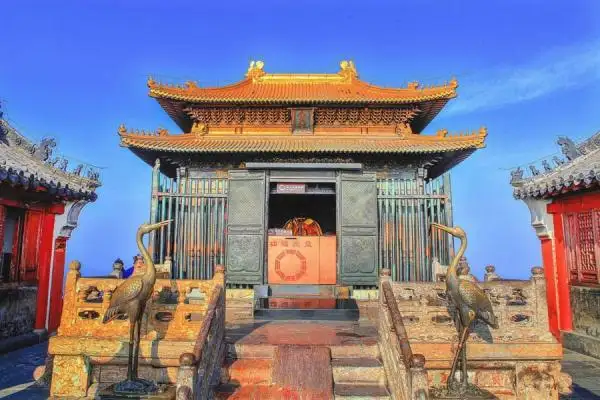
Thus, in the tenth year of the Yongle reign (1412), Zhu Di mobilized approximately 300,000 people to construct eight public temples, two guan temples, thirty-six Yantang temples, and seventy-two Yan temples, a project that lasted over ten years. Even today, some people claim that the Zhenwu statue in the Golden Hall of Tianzhu Peak is modeled after Zhu Di himself.
>> Further reading: Top 6 Greatest Dynasties of China (including Ming, Tang, Qin...)
Speaking of sacred imperial mountains, we must also mention Mount Tai, the highest mountain in eastern China. It was the highest hall for ancient Chinese emperors to communicate/connect with Heaven, where "imperial power was bestowed by Heaven, and the Fengshan ceremony was held to inform Heaven." From Qin Shi Huang to Emperor Zhenzong of the Song Dynasty, many emperors performed the Fengshan ceremony on Mount Tai.
>> Explore the Most famous China’s mountainsWudang Sect: Quanzhen School VS Zhengyi School
Interestingly, despite the deep historical ties between Wudang Mountain and the emperors of the Ming Dynasty, if you visit Wudang Mountain, the name you'll most likely hear people talking about is not Zhudi but Zhang Sanfeng (if you can understand Chinese language). Who is he? The legendary grandmaster of Wudang Mountain.
Zhang Sanfeng was a Taoist priest from the late Yuan and early Ming dynasties. He came to Wudang Mountain, observed its landscape, and predicted its future prosperity. Therefore, he led his disciples to establish temples. By the time Zhu Di (Emperor Yongle) extensively renovated Wudang, Zhang Sanfeng had already gone into seclusion, but he was given high honors in Taoism. During the reign of Emperor Yinzong of the Ming Dynasty, he was bestowed the title "Tongwei Xianhua Zhenren" (Perfected Man of Transformation and Power), and during the reign of Emperor Shizong, he was further bestowed the title "Qingxu Yuanmiao Zhenjun" (True Lord of Pure Emptiness and Profound Mystery). He is revered as the patriarch of the Wudang Sect.
Those interested in Wudang Kung Fu will also be familiar with Zhang Sanfeng, as he created the Wudang internal martial arts.
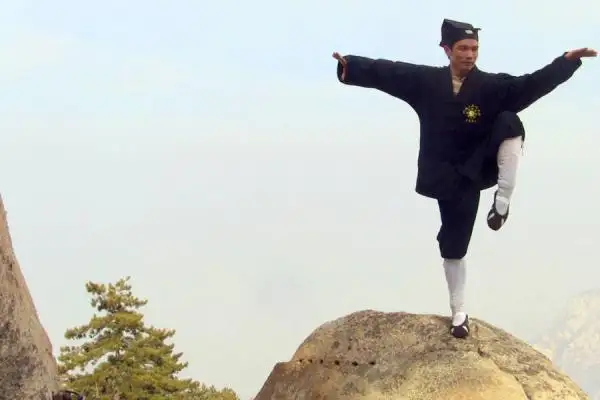
However, Zhang Sanfeng was not actually the founder of the Wudang Sect. He was later considered to belong to the Quanzhen School, a branch of the Wudang Sect. So now we explore the two major schools of Chinese Taoism, the Zhengyi School and the Quanzhen School, The differences between them are actually quite significant.
The Zhengyi School is said to have been founded by Zhang Daoling around 126 AD, at the end of the Eastern Han Dynasty. It primarily spread its teachings among the common people during a period of social chaos, guiding them to help and relieve each other. It didn't particularly emphasize the profound doctrines and strict precepts of Taoism.
The Quanzhen School, emerged nearly 900 to 1000 years later, originating in the 7th year of the Dading era of the Jin Dynasty. At that time, many social elites, unable to bear the oppression of northern tribes, went to the mountains to cultivate Taoism. Therefore, the Quanzhen School places greater emphasis on personal cultivation, stressing internal alchemy and the unity of the three teachings (Confucianism, Taoism, and Buddhism).Let's look at the specific differences between the two schools. The Zhengyi school places more emphasis on the practical needs of ordinary people. If they're hungry, someone will give them food; if they're sick, someone will burn talismanic water for them; if they think their child is possessed, someone will exorcise the ghost. The Quanzhen school, on the other hand, involves genuine mountain cultivation and understanding of the essence of Taoism.
Therefore, the Quanzhen school has many precepts. They must become monks, live in Taoist temples, cannot marry, must be vegetarian, and cannot drink alcohol. However, Zhengyi Taoists can marry, practice at home, eat meat, and drink alcohol.
Of course, you might be more concerned about whether the kung fu of the Wudang School is real. You can visit a Wudang grandmaster yourself. Nowadays, even some international tourists study Taoist philosophy and learn kung fu, including Wudang taichi boxing and Wuadng swordsmanship.
>> Recommend China Kung Fu tours:
Taoist Priests vs. Buddhist Monks: Both are Ordained, But Why the Difference?
If you're interested in religious culture and have visited some of China's famous religious mountains, you'll find that both Taoist priests and Buddhist monks are ordained, but their acceptance by the Chinese public is drastically different. Maybe you have heard Chinese culture is based on Confucianism, which centers on the family. Leave the family and becoming a monk was major taboo in Chinese culture.Buddhism initially faced numerous setbacks when it entered China. Let's explore the reasons. Firstly, one's body and hair are received from one's parents; how could one dare to shave one's head? Thus, in the eyes of Confucianism, shaving one's head in Buddhism is a great act of filial impiety. Secondly, Chinese people value filial piety towards parents and loyalty to the emperor. Buddhist monks do not bow to parents or the emperor, directly challenging core Chinese values.
Thirdly, Chinese culture emphasizes the continuation of lineage and inheritance. Buddhist saints must remain celibate, severing their offspring. Fourthly, Buddhism views the family as a prison and a sea of suffering. Therefore, Confucianism believes that Buddhist ordaining is essentially a negation of secular family theory. Buddhism was only able to survive in China after it underwent significant revisions.
>> Further reading How Buddhist Grottoes Evolute & Blends with Chinese Culture
But don't Taoist priests also renounce worldly life? The Wudang sect is like the Quanzhen sect. The Taoist priests and nuns in their temples don't marry, are vegetarian, and live far from family. So how is their renunciation different from Buddhist renunciation? Talk to them and you'll know the answer.
Taoist renunciation is actually completely different from Buddhist renunciation. The Quanzhen sect is rooted in Confucian family ethics. The ultimate goal of Taoist renunciation is to bring honor to one's ancestors. Buddhism speaks of reincarnation; one cultivates Buddhism in this life for the next, completely abandoning family. But Taoism doesn't talk about reincarnation. Taoist renunciation is about becoming an immortal. After becoming an immortal, one brings honor to one's ancestors and may even bring prosperity to one's entire family.
In Taoist stories, the Jade Emperor was supposedly originally a wealthy landowner; after becoming an immortal, his wife became the Queen Mother of the West. So, when someone cultivates Taoism and becomes an immortal, they are actually working for their whole family and can even benefit their descendants. In Confucianism, this is the greatest filial piety.
Furthermore, while Taoist priests renounce worldly life for longevity, they do not deny secular life. They emphasize cultivating humanity, valuing loyalty, filial piety, and righteousness cultivating the Tao. Historically, the Zhengyi School served the masses. And they even lacked strict rules and regulations, allowing marriage and children. The Wudang and Quanzhen sects were composed of prominent figures who cared deeply about the nation and its people.
For example, during World War II, Liu Jiaoming, a Taoist grandmaster from the Nanyan Palace on Wudang Mountain, led more than ten Taoist priests down the mountain in 1938 to join the army and fight against the Japanese. Pang Gaocheng, a Taoist grandmaster from Qiongtai Zhongguan, fought against the Japanese in Hubei and Henan. After the victory, he returned to the Mt. Wudang to continue his Taoist practice.
Recommend China Religious Tours of Taoism and Buddhism
The Complementarity of Taoism and Confucianism
We have discussed the differences between Taoist priests and Buddhist monks, and explained that Taoism is not incompatible with Confucianism or traditional Chinese culture. Furthermore, Taoism even complements Confucian filial piety.Confucianism emphasizes that one should fulfill the duty of filial piety during one's lifetime. But what happens after death? Confucianism doesn't address this. Taoism fills this gap by performing rituals to pray for the souls of the deceased. Therefore, Taoism fills the gaps in Confucianism's metaphysical, religious, and theological aspects.
>> Recommended China tours to Wudang Mountain