Xijiang Miao Village: Discover the Thousand Household Miao Village in Guizhou
Travel in Kaili
Guizhou Festival Tours to Kaili
Hot China City Tours
Table of Contents
- 1. What is Xijiang Miao Village - History
- 2. Highlight Attractions & What to See
- 3. Top Things to Do in Xijiang Miao Village
- 4. How to Visit Xijiang Miao Village: Travel Tips
Located in the southeast of Kaili, Xijiang is the largest Miao community in China, where more than 1000 Miao families (population: >6000) live, hence the name Xijiang Qianhu Miao Village (the Thousand Household Miao Village). It is surrounded by mountains and rivers. The huge village itself is just like a forest of Miao wooden cabins built from the foot to the mountain top.
Xijiang Miao Village is also called the Capital of Miao due to its grandeur. Many scholars regard it as the Gallery of Miao Folk Art and the Living Fossil of Miao history and culture. No wonder it is one of the best things to do in Guizhou.
During your Guizhou trip to Xinjiang, you will not only see their unique architecture, but also their way of life. One of the villages has the best Miao silver smith, producing all kinds of silverware for their people.

Quick Xijiang Miao Village Facts
What is Xijiang Miao Village - History
The Miao people originated in the Yellow River Basin and are said to be descendants of the ancient Chiyou. From the great battle between Huangdi, Yandi and Chiyou, the era of Yao, Shun, and Yu, to the Tang, Song, Yuan, Ming and Qing dynasties, they experienced five major migrations and dispersed to live all over the world. The Xijiang Qianhu Miaozhai of China is the largest Miao village in the world.
The Miao people in Xijiang Town belong to the Xi clan. More than 600 years ago, when they moved to Xijiang, there were already Miao people of the "Shang" clan living there. The "Xi" clan asked the "Shang" clan for the settlement and they lived together, called it "Xishang", and later it was pronounced as "Xijiang" due to the phonetic similarity.
The current Xijiang Miao Village is composed of eight natural villages: Pingzhai, Baiyan, Yangpai, Dongyin, Wuga, Shuizhai, Nangui, Yeyan.
>> Further reading about Miao tribe, people, culture and traditions
Highlight Attractions & What to See
Xijiang Miao Ethnic Museum
The Xijiang Miao Ethnic Museum features the unique stilt houses - a typical Miao architectural style. The museum has a total of 11 exhibition halls, namely the entrance hall, history hall, production hall, festival hall, dance and song hall, architectural skills hall, clothing and silver jewelry hall, sports and Miao medicine hall, witch culture and religious belief hall, life hall, and multimedia multi-functional hall.
The museum houses over 1,220 Miao ethnic cultural relics and more than 350 representative pictures, portraits, and books, covering Miao ethnic history, production, life, festivals, music, dance, clothing, silver jewelry, Miao ethnic medicine, and architecture. The Xijiang Miao Ethnic Museum is one of the best places for researching and understanding Miao ethnic culture.
Observation Platform
The observation platform is a must-visit and the best location for viewing the Xijiang Miao Village. During the day, when looking down from the observation platform, the first thing that catches your eye is the panoramic view of Xijiang Miao Village: the wooden buildings with sloping roofs, the rural scenery, and the farming life.
At night, when viewing Xijiang from the observation platform, the entire village is illuminated with twinkling stars and bright lights. The flowing water, green trees, ancient streets, wooden bridges, and sloping wooden houses complement each other, and from a distance, the village looks like a silver butterfly about to take flight.
Gage Ancient Alley
On both sides of the ancient lane, old wooden houses have dark red wooden walls painted with ethnic customs murals. The vividly painted murals record the mysterious totems, beautiful legends, and grand Miao New Year. There is "Yuan Xijiang" in the ancient lane, which witnesses the earliest history of Xijiang. "Jia Ji Bridge" showcases the ancient sacrificial bridge culture of the Miao people. The oral epic songs, intangible cultural heritage of Miao embroidery, silverware forging, and Lei Shan green tea, which were created by the ancestors of the Miao ethnic group during their long-term production and life practices, are also displayed here.Idyllic Rural Scenery
The terraced fields stretch from the foot of the mountain to the top. The Miao people raise fish in the fields. The fish consume the rice flowers and become rice-flower fish. The fish swim in the fields, and apart from the weeds, they also nourish the rice.>> Recommended 2 Days Kaili Tour to Xijiang Miao VillageTop Things to Do in Xijiang Miao Village
The Xijiang Thousand-Household Miao Village in Guizhou is actually more like an open-air museum. Here, farming, festivals, silver jewelry, clothing, cuisine, music and dance, etc., all the local customs and traditions have been passed down from generation to generation.An in-depth Experience of Miao Ethnic Minority Culture
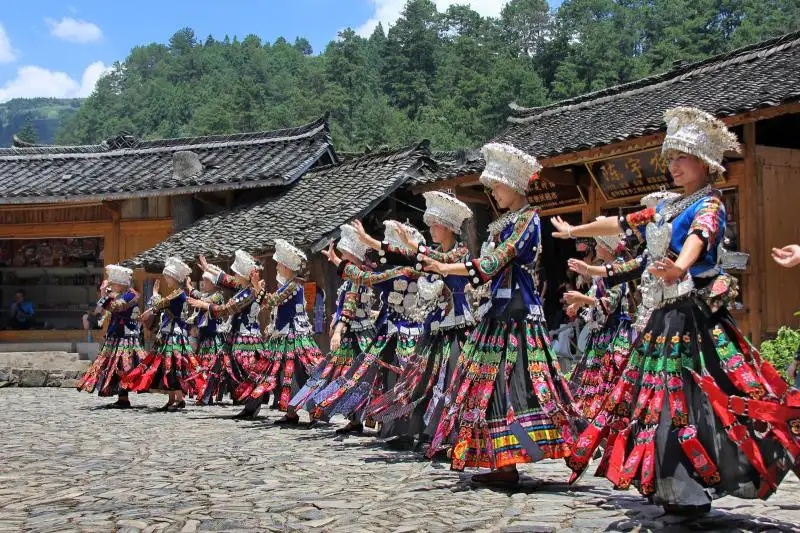
The Miaos love dancing and singing. Their songs are attractive and embody their culture, history, and human feeling, which are passed from generation to generation. It includes wine songs, love songs, folk songs, and so on. Love songs are characterized by their fair-sounding tune; folk songs are characterized by their loud and sonorous tune. When planning your Guizhou tour to Xijiang, enjoy and even join the locals for singing and dancing. >> Learn more about Ethnic Groups in China
Admire Traditional Miao Wooden Houses
During each of the large-scale migrations, the Miao people always hid in remote mountainous areas, thus forming the tradition of building wooden houses on stilts. Stilt house architecture is the wisdom achievement of the Miao people when they lived in seclusion in the perilous mountainous regions. The skill that the Miao people must master after birth is to learn how to build hanging-wooden houses. The wooden stilt houses in the Xijiang Miao Village are built along the mountains, stretching in a continuous line and presenting a magnificent appearance.
Taking into account the improvement of the village's feng shui conditions and the convenience of residents' lives, Xijiang has wind and rain bridge at the Pingzha and Ou'ga junction in Pingzhai, and the Nanshou Wind and Rain Bridge built in Nan Gui Village to block the entire feng shui of Xijiang.
>> related reading: The Most Distinctive Traditional Dwellings in ChinaDrink Twelve Welcoming Wines and the “Flowing Water of Mountains and Rivers”
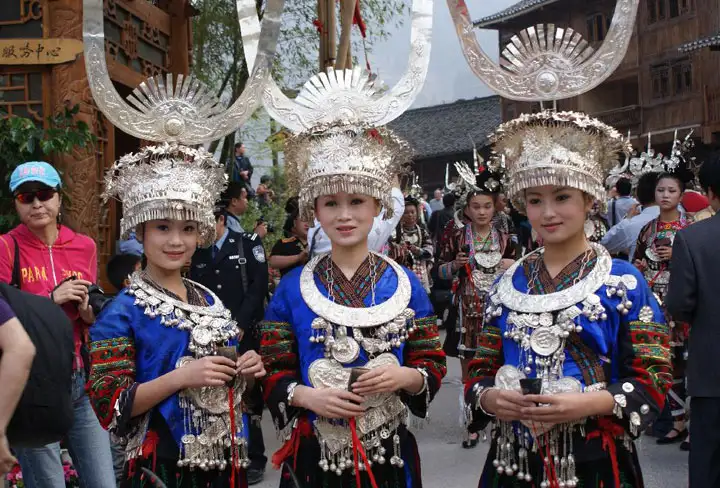
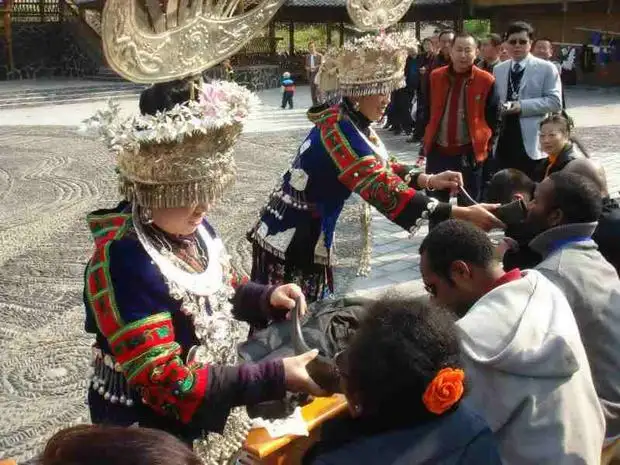
The Miao people are a nation that expresses emotions through wine. So when guests arrive, they will be treated with fine wine. At the north/west entrance of the Xijiang Qianhu Miao Village scenic area, the Miao people dressed in their finest attire present twelve welcoming wines, expressing their best wishes to the guests.
What is the "Flowing Water of Mountains and Rivers"? The girls sing while holding a bowl of Miao self-brewed glutinous rice wine, and the boys play the lusheng while rhythmically stepping and dancing, happily approaching the guests. The girl leading the way was singing while gracefully moving her body and smilingly gesturing to indicate that the guests should drink. The guests then drink the wine without holding the bowl themselves.
Take the Sightseeing Cable Car
Taking the sightseeing cable car, you can overlook the natural scenery of Xijiang Miao Village from high up.Long Table Banquet
The longest-lasting long table banquet is the most grand Miao ethnic feast. It features unique Guizhou cuisine, such as Miao village sour soup fish, drum meat, glutinous rice cake, cured sausage, accompanied by the melodious Lusheng music, the Miao girls' toasting songs, and a bowl of the fragrant rice wine. You can truly experience the daily life of the Miao people.Miao festival celebrations
In the Qianhu Miao Village of Xijiang, don't miss the Eating New Festival, the Miao New Year Festival and the Guzang Festival. During these festivals, there will be wonderful traditional performances and activities such as the dancing of Lusheng music & dancee, bull fighting, bird fighting (sparrow fighting), and chicken fighting.
>> Recommended China Guizhou Tours:
How to Visit Xijiang Miao Village: Travel Tips
Best Time to Visit Xijiang
Located in the subtropical humid mountainous monsoon climate zone, the Xijiang Thousand-Household Miao Village receives an annual precipitation of approximately 1300 to 1500 millimeters, with an average annual temperature of 14 to 16 degrees Celsius. There is no severe cold in winter and no intense heat in summer. Therefore, you can visit this place throughout the year.Xijiang Miao Village Hotels
Based on the terrain of Xijiang Qianhu Miao Village - built along the mountain. Therefore, there are three options for accommodation: at the top of the mountain, on the mountain slope, or at the foot of the mountain.The biggest advantage of staying at the top is the wide view, allowing you to overlook the entire village. The hotels on the higher part of the east bank are concentrated around Gucangtou, while those on the higher part of the west bank are around the viewing platform.
Living at the mountain slope allows you to see the thatched houses surrounded by morning mist without leaving the room. It is divided by the Bai Shui River. The guesthouses on the west bank are recommended to choose near the No. 4 and No. 5 wind and rainbridge, which is in the center of the village and offers a panoramic view of the village through the window. The guesthouses on the east bank are recommended near the Miao Ethnic Museum, which is convenient for travel. The disadvantage is that you need to carry your luggage and climb the mountain to check in by yourself.
Staying at the hotel at the foot of the mountain saves effort in carrying luggage and is cheaper. It is recommended near the rural landscape area,which is particularly quiet at night.The best hotels are Xijiang Qianhu Miao Village Sanchunli·Ji Panoramic Beauty Guesthouse and Xijiang Xunmei·Banshan Resort Hotel Qifengxin·Xuyan Luxury Villa Hotel.How to Get to Xijiang Miao Village
From Guiyang Airport
The Longdongbao Airport in Guiyang is about a 3-hour drive from Xijiang Qianhu Miao Village. After arriving at Longdongbao Airport by plane, you can take a high-speed train to Kailin South Station. Or you can take the scenic bus directly to Xijiang Qianhu Miao Village.In addition, the nearest airport to Xijiang is Kaili Huangping Airport, but currently there are only a few flights.Bus from Kaili to Xinjiang
Departing from the bus station in Kaili, there are direct buses to Xijiang Thousand-Household Miao Village. The journey takes about 1 hour and the ticket price is approximately 20 yuan per person. There are usually about 3-4 buses a day. The specific schedules can be found in the timetable at the Kaili Bus Station.Direct Expresses
Currently, there are direct expresses from Kaili South Station, Guiyang Longdongbao Airport, Zhenyuan Ancient Town, Li Bo, Huangguoshu Waterfall to the Xijiang Miao Village Scenic Area. The frequency of the direct train services may change at any time depending on the season and weather conditions.
Recommended Visiting Route
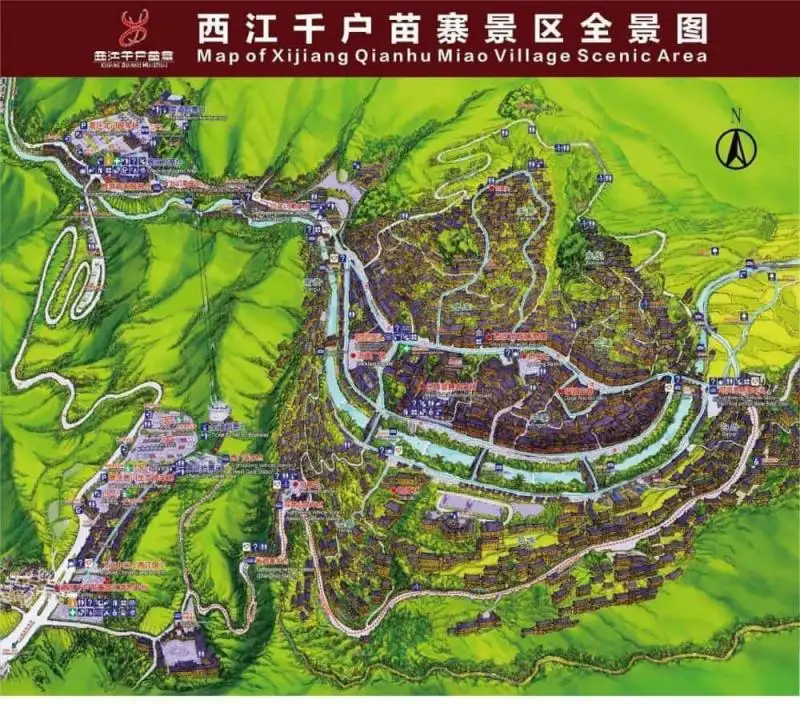
Xijiang Miao Village Visitor Service Center (West Gate) → Welcome Square → West Street (Tourist Goods and Food Street) → Scenic Area Ticket Gate → Popular Cable Car → North Gate Bus Stop → North Gate → Core Scenic Area Tour (Necklace Square - No. 4 Wind and Rain Bridge - Post Office - Drum Road (Yedong Village) - Drum Hall - Drumming Ground - Xijiang Miao Museum - Lusheng Field - Xijiang Lecture Hall) → No. 1 Wind and Rain Bridge Bus Stop → Viewing Platform → Changxiao Bus Stop → West Street → West Gate Ecological Parking Lot
Enter from North Gate or West Gate?
Firstly, the village has two entrances: the North Gate and the West Gate. Which gate to choose to enter depends on the location of your hotel. If your hotel is near the No. 1 and No. 2 Bridge of Wind and Rain, or near the viewing platform, it is recommended to enter through the West Gate. If your hotel is near the No. 3 to No. 7 Bridge of Wind and Rain, then the North Gate is a better choice.More Attractions in Kaili